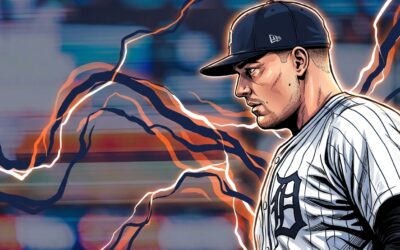
Rob Thomson went out the way he came in: with class. After the Phillies fired him on April 28 following a 9-19 start tied for the worst record in baseball, Thomson sat at a podium and said exactly what you’d expect a good baseball man to say: “When you’re not playing well, and you’re the manager of a ball club, you’re held accountable, and rightly so.” Then, when asked what he’d do next after 42 years in the game, he said he might take a swim in the pool his wife had installed.
Rob Thomson, when asked what he will do now after being fired by the Phillies: "I got no idea. I really have never spent a summer in 42 years at home, so I really don't know.
Thank God my wife put a pool in a couple years ago, so maybe I'll go for a swim or something.''— Bob Nightengale (@BNightengale) April 28, 2026
That’s the man they fired. A .568 career winning percentage in Philadelphia — the best mark by any Phillies manager since 1900. Four consecutive postseason appearances. A 2022 World Series berth. Back-to-back NL East titles in 2024 and 2025. Thomson didn’t lose this team. He won more than anyone had in over a century.
The person who should be sitting at that podium answering hard questions is Dave Dombrowski.
Dombrowski — Philadelphia’s president of baseball operations and the architect of a roster carrying a payroll north of $300 million, the largest in franchise history — was asked directly at his press conference whether Phillies fans should still believe he is the right person to run the front office. His answer: “You can answer that question. I’m not gonna get into that.”
That is not accountability. That is a man watching someone else take the heat for his construction project catching fire.
The numbers are brutal, and they don’t point to Thomson. Philadelphia’s 2026 offense ranks 29th in wRC+ (83) and is slugging an OPS of .656. The pitching is 28th in ERA at 5.13, with opponents hitting .286 — the worst mark in the league. The run differential sits at -54 across 28 games. The cleanup hitters are posting a combined .545 OPS, second-worst in baseball. These are roster-construction numbers; they are not lineup-card numbers. No manager in baseball is drawing up lineups that turn a .656 OPS offense into a pennant race. As Joel Sherman put it on MLB Now: “Would Casey Stengel and Joe McCarthy as his bench coach win with these rosters?”
The structural reality is straightforward: Dombrowski built a contention window around an aging core — Bryce Harper, Kyle Schwarber, Trea Turner, and J.T. Realmuto all either turned or will turn 33 during the 2026 season. Zack Wheeler came back from thoracic outlet syndrome surgery with no certainty about what he’d be on the other side of it. Ranger Suárez, their best starting pitcher not named Wheeler, departed as a free agent after 2025. The window was visibly narrowing; the investment kept growing.
Dombrowski has been here before. He ran the Detroit Tigers through an eerily similar arc — a high-payroll core built around Miguel Cabrera and Justin Verlander that won division titles without winning a title, then collapsed as the players aged and the depth failed to materialize. He left Boston in 2019 under comparable conditions: big contracts, limited organizational depth, a structural hangover the next front office had to absorb. The Phillies hired him knowing this history.
There is also the detail — reported before Thomson was even let go — that Dombrowski approached Alex Cora about the managerial job while Thomson was still employed. Cora declined, citing family. So Dombrowski wasn’t just letting Thomson go because of performance; he was already shopping for a replacement while the manager was still managing. Don Mattingly, now named interim, has the distinction of being the first man to manage a team while his son serves as the GM. That is either a remarkable story or a nepotism minefield — probably both — and it raises its own set of questions about how this organization actually functions.
Pittsburgh fans understand what a real rebuild looks like. The Pirates have been doing it the hard way: drafting Paul Skenes, watching him win the 2025 NL Cy Young unanimously with a 1.97 ERA, developing Konnor Griffin into the consensus number-one prospect in baseball, absorbing the losing and the bad attendance and the criticism because that’s what building properly costs. The Pirates are sitting at 18-16 entering May — not a contender, not pretending to be, but genuinely moving toward something real.
The Phillies tried to skip that phase. They won enough to make four straight postseasons, which is real and should be credited — but they never built the depth to sustain it, and when the core aged simultaneously, there was nothing underneath to cushion the fall. That’s a front office failure. The window didn’t close on Thomson; it closed on Dombrowski’s roster model.
Thomson’s graceful exit deserves acknowledgment: he accepted accountability for a situation he didn’t create, wished his players well, and meant it. Dombrowski sat at the same press conference and insisted “we’re a much better club than this” — a claim the data refuses to support — before deflecting the most important question anyone asked him all day.
The lesson for Pittsburgh isn’t complicated. Build sustainable depth. Don’t rush the window. And when the failure comes — because it always comes eventually — make sure the person holding the shovel is the person who dug the hole.